

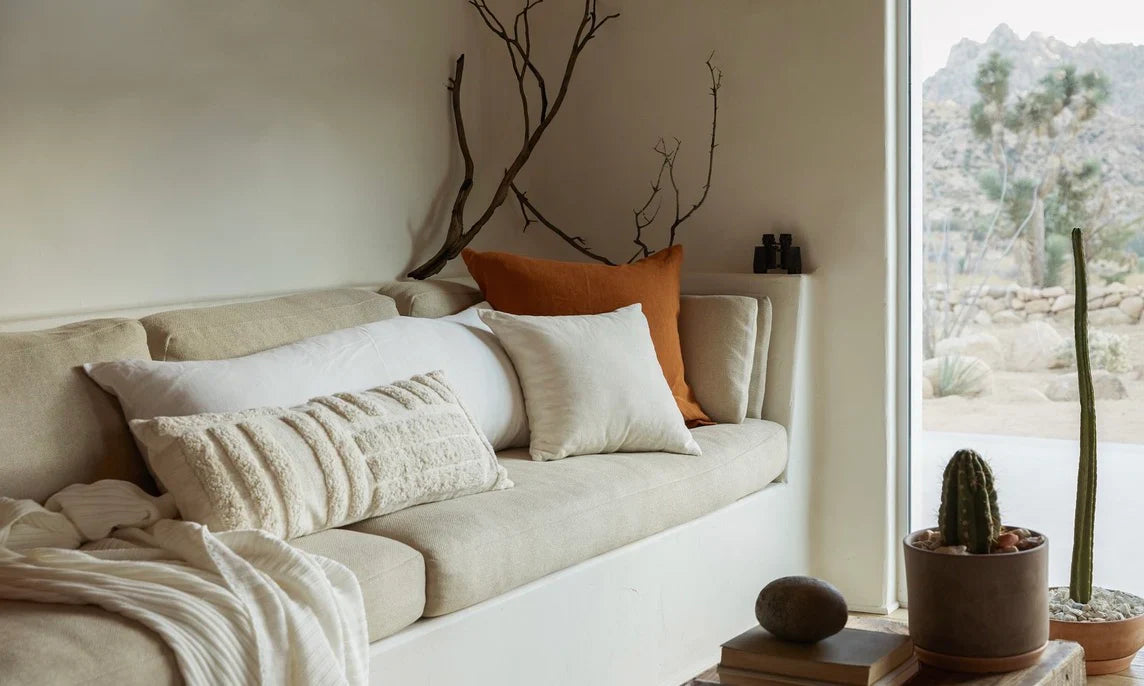
Pillow Decor: How to Style Throw Pillows Like a Designer
Throw pillows are the most frequently rearranged element in any home. They're also the most frequently gotten wrong — too many, too matched, too symmetrical, too flat. The difference between a sofa that looks like a showroom and one that looks like a genuinely designed space often comes down to how the pillows are handled.
This guide covers the formula professional designers use: the right sizes, the mixing logic, the arrangements that work, and the materials worth spending money on.

The Size Formula
Size is the foundation of pillow styling — and the element most people skip entirely. Pillows that are all the same size create flat, monotonous arrangements. Varying sizes creates depth and visual movement.
The standard designer formula for a three-cushion sofa:
• Two 24" square pillows at the outer ends — the anchors. These are the largest and most substantial.
• Two 20" square pillows layered in front of or offset from the 24s. These are the mid-layer.
• One 18" square or lumbar pillow in the center — the accent. This is where the most expressive pattern or texture goes.
For a two-cushion sofa, scale down: two 22" pillows and one 18" or lumbar accent. For an armchair, one 20" or 22" is enough — piling multiple pillows on a chair reads as messy rather than layered.
Mixing Patterns: The Three-Category Rule
The most reliable pattern-mixing formula uses three categories of pattern simultaneously. Within a single arrangement:
• One solid or texture-only pillow. This is the visual rest. Boucle, waffle weave, velvet, or linen in a solid color gives the eye somewhere to pause between patterns.
• One small-scale or geometric pattern. Thin stripes, small checks, subtle grids, or micro-prints. These add visual interest without competing for attention.
• One large-scale or statement pattern. A bold print, a large geometric, an abstract mark. This is the pillow that carries the personality of the arrangement.
The unifying element across all three: color. Pull one or two colors from the statement pattern and make sure they appear in the other pillows — as the dominant color of a solid, or as an accent color in the geometric.
|
The Lumbar Pillow: Underused and Transformative A lumbar pillow — rectangular, typically 14" x 22" or 12" x 20" — does something no square pillow can: it introduces a horizontal element that breaks the vertical rhythm of a standard pillow arrangement. It's also where the most distinctive pattern or texture in a room often belongs, because its position in the center of a sofa makes it the most seen object in the arrangement. Use one lumbar in the center of any sofa arrangement with two or more square pillows flanking it. On a daybed or chaise, a lumbar at one end with one or two square pillows at the other creates a natural resting position. |
Mixing Textures: What Works Together
|
Texture |
Works With |
Avoid Pairing With |
Notes |
|
Linen |
Velvet, leather, cotton, boucle |
Synthetic satin or polyester |
The most versatile neutral texture |
|
Velvet |
Linen, cotton, leather |
Other velvet (too much) |
Rich texture; use as one element, not all |
|
Boucle |
Linen, cotton, leather |
Heavily printed fabrics |
Texture-forward; keep patterns minimal nearby |
|
Leather / faux leather |
Linen, cotton, woven |
Velvet (both too high-texture) |
Works best as one piece in a mixed arrangement |
|
Embroidered |
Solid linen or cotton |
Other embroidered or heavily printed |
Let it be the statement piece |
|
Waffle weave |
Almost anything |
— |
Neutral texture — the ultimate mixer |
Arrangement Styles That Actually Work
The symmetrical arrangement — matching pillows on each end with an accent in the center — is the most traditional approach. It works in formal and traditional rooms. The risk: it can feel rigid and catalog-like if all the pillows are too coordinated.
The asymmetrical arrangement — different pillows on each end, varied sizes staggered — creates a more personal, collected look. It requires more confidence but rewards it with a room that feels genuinely designed rather than assembled.
The stacked arrangement — pillows layered in front of each other from back to front, largest to smallest — is the most common designer approach. It creates depth and makes the sofa look full without being crowded.
The lean — one or two pillows leaned against the sofa back at an angle rather than placed upright — is the signal of an unstyled sofa in the process of being lived in. It works; it reads as relaxed rather than staged.
Materials Worth Spending Money On
Pillow covers are changed more often than pillows themselves — which makes the cover quality more important than the insert quality in most cases. What to look for:
• Inserts: a down or down-alternative insert gives pillows their fullness and 'chop.' Polyester fiber fill compresses over time and never recovers its shape. Invest in quality inserts — they're the foundation everything else rests on.
• Cover fabrics: linen, cotton velvet, boucle, and woven textiles all hold up better than synthetic alternatives. Natural fibers also breathe better and feel better to the touch — which matters for pillows you actually sit against.
• Closure type: invisible zipper closures are the most professional finish. Button and envelope closures also work. Visible zippers on the front of a pillow read as inexpensive regardless of the fabric quality.
Browse S.W. Home's home accessories and textile collection for pillow covers, home textiles, and decorative objects that bring the same intention to every room.
|
Shop Textiles & Home Accessories at S.W. Home Pillow covers, textiles, and home accessories selected for material quality and lasting style. Browse the S.W. Home collection. |
