

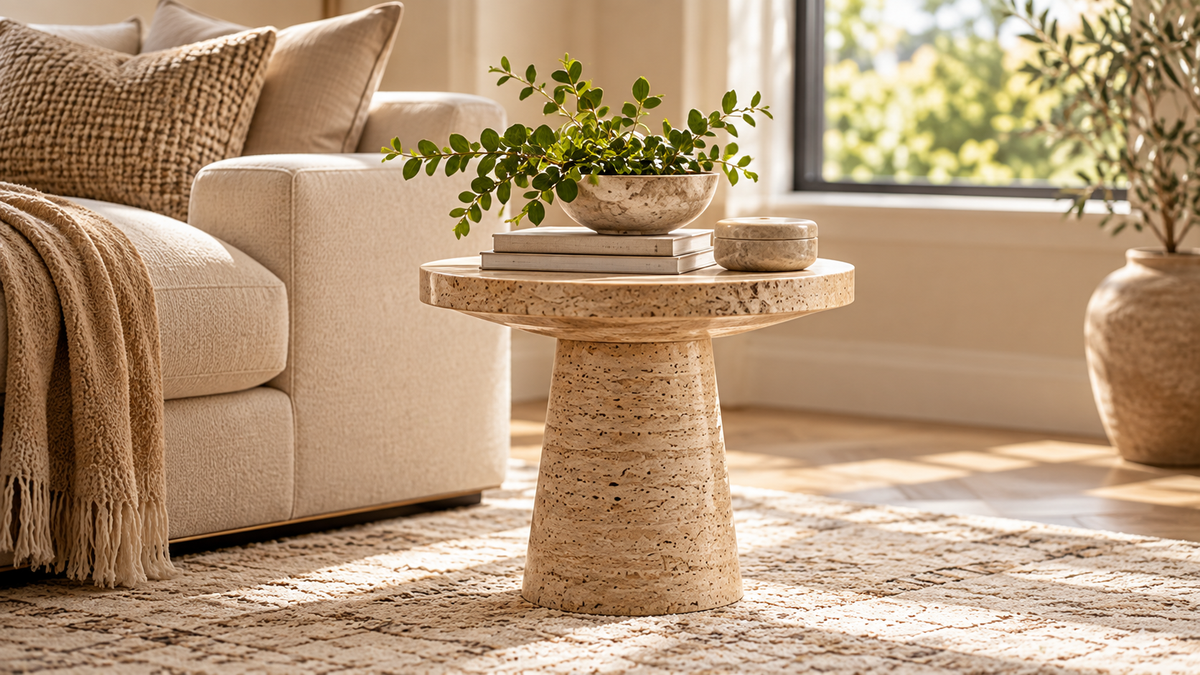
Pedestal End Table: The One Table Form That Works in Every Room

The pedestal end table is the most space-efficient and visually versatile accent table form available. A single column rising from a base to a flat top — it looks good from every angle, fits into tight spaces, and works beside a sofa, in a bedroom corner, in a bathroom, or at the end of a hallway. If you're looking for one accent table that earns its place in multiple contexts, a pedestal is that table.
What Defines a Pedestal End Table
A pedestal end table has a single central column (the pedestal) connecting a base to a tabletop. Unlike four-legged tables, the pedestal has no corner legs extending into the room — it takes up only the footprint of its base, which is typically much smaller than the tabletop it supports.
This geometry makes the pedestal end table uniquely functional in tight spaces: it can sit close to a wall, squeeze into a narrow space beside a chair, or stand in a corner without legs jutting into a walkway.
Pedestal End Table Materials and What Each Brings
• Wood: Warm and organic. Works in traditional, transitional, and organic-modern rooms. Turned wood pedestals have a classical quality; smooth tapered wood reads as contemporary
• Metal: Light, open, and modern. A metal pedestal with a marble or glass top is one of the most popular current formats. Works in contemporary, industrial, and transitional rooms
• Ceramic or concrete: Heavy, sculptural, and organic. A ceramic or terracotta column base reads as a decorative object as much as a table
• Stone: The most contemporary option. A solid stone pedestal (marble, travertine, limestone) has immediate visual weight and presence. High-end and distinctive
• Rattan or woven: Natural and organic. A rattan or woven pedestal base works in coastal, bohemian, and organic-modern rooms
The Right Height for a Pedestal End Table
The most important dimension in any end table purchase is height relative to the seat arm beside it. The table surface should sit within two inches of the sofa or chair arm — either just above or just below.
|
Seating Type |
Ideal Table Height |
|
Standard sofa (23–25" arm height) |
22–26 inches |
|
Low/mid-century sofa (18–22" arm) |
18–23 inches |
|
Armchair or accent chair (24–28" arm) |
24–28 inches |
|
Bed (standard queen at ~25") |
24–28 inches |
Where a Pedestal End Table Works Best
• Living room: Beside the sofa arm. The pedestal takes less floor space than a four-legged table, which matters in smaller living rooms
• Bedroom: As a nightstand beside a bed. The pedestal form is particularly good here — no corner legs to catch on when you reach down in the dark
• Bathroom: A small pedestal table beside a freestanding tub or beside a chair in a larger bathroom is an increasingly common and highly functional placement
• Hallway or entryway: A tall, slender pedestal table at the end of a hallway holds a small vase or object and creates a visual stopping point
• Reading corner: A pedestal end table in a reading corner — beside the chair, holding a lamp and a small stack of books — is a complete vignette in a small footprint
Styling a Pedestal End Table
The top surface of a pedestal end table is small — usually 12 to 18 inches in diameter. That constraint is its strength: it forces editing. The most common and effective arrangements:
• A lamp + one small object (a candle, a small vase, a stone). Functional and complete
• A small stack of two or three books + one object on top. Adds height and interest without crowding
• A single statement object — one ceramic vase with a stem, one distinctive sculptural piece. Let the pedestal be the furniture; let one object be the decoration
|
Find pedestal end tables and accent furniture at S.W. Home → shopswhome.com |
