

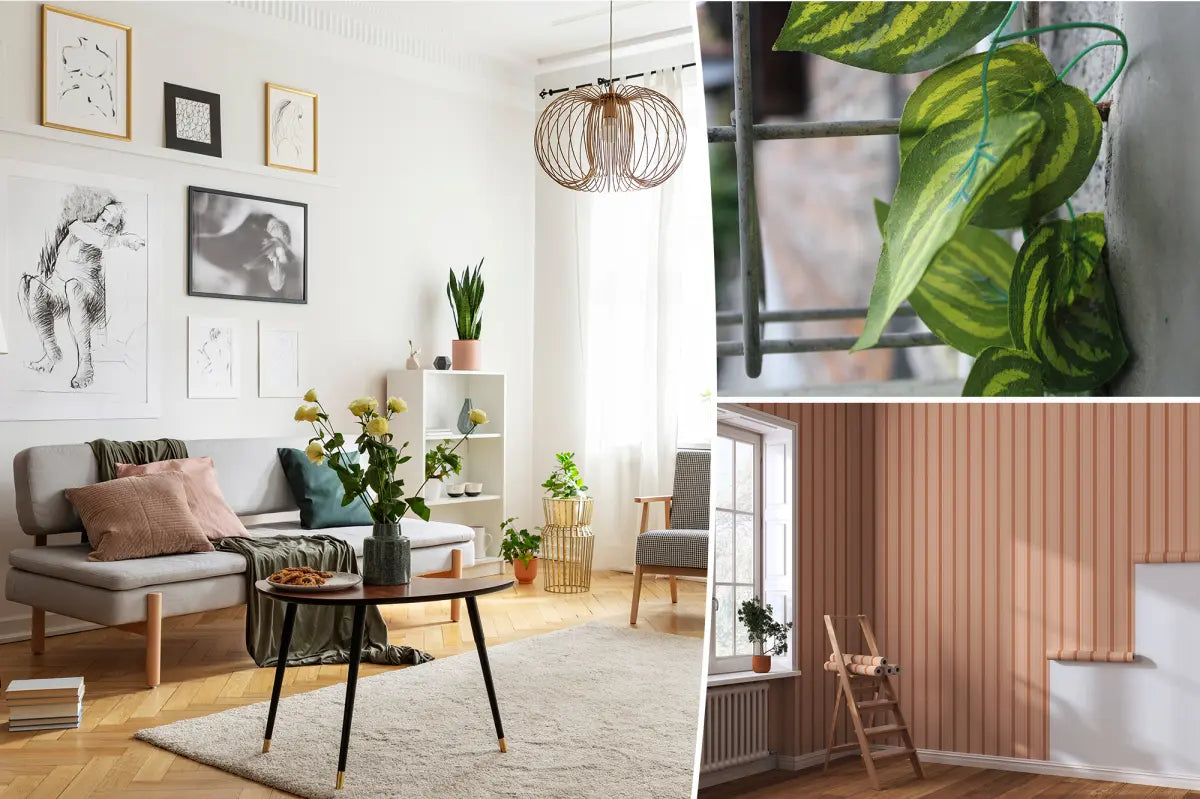
Interior Decor That Feels Personal, Not Generic
You can walk into two homes with nearly identical furniture, the same neutral palette, and comparable budgets — and one will feel like a place someone actually lives while the other feels like a showroom. The difference isn't money. It isn't square footage. It's whether the space carries any evidence of the person inside it.
Generic interiors aren't bad interiors. They're just anonymous ones — spaces that could belong to anyone, which means they feel like they belong to no one in particular. Personalization in interior decor isn't about display or self-expression for its own sake. It's about making choices that reflect genuine preference, accumulated experience, and real life — and the result is a home that holds up to living in because it was built around that life from the start.
Why Generic Happens — and Why It's So Easy to Default To
Generic interiors aren't usually the result of bad taste. They're the result of shopping from a small number of sources, following trend content too closely, and prioritizing visual coherence over personal resonance. When every buying decision runs through the same handful of retailers and the same algorithm-driven inspiration feeds, the outputs converge — regardless of who's doing the decorating.
The other driver is caution. Personal choices feel risky. A piece of art that means something to you might not mean anything to a guest. A color you love might not be universally appealing. A room that reflects your actual life — your travels, your collections, your family history — opens you up in a way that a neutral, trend-forward room does not.
That vulnerability is exactly what makes a space feel personal rather than generic. The rooms people remember — and want to return to — are the ones that told them something about the person who lives there.
The Difference Between Decorated and Personal
A decorated room has been attended to. Furniture is placed, surfaces are styled, art is hung. A personal room has all of that — and something more. It has specificity. You could not recreate it by shopping from a catalog, because some of what's in it can't be purchased: the story behind a piece, the reason a color was chosen, the object that traveled home from somewhere that mattered.
The practical difference shows up in the details:
• Where things came from. A room furnished entirely from one retailer reads as assembled. A room built from multiple sources — a boutique shop, an antique market, a family inheritance, something handmade — reads as collected. The diversity of origin is part of the character.
• Whether objects have reasons. Decorative objects placed for decoration's sake are visible as exactly that. Objects placed because they mean something — because they were found somewhere, made by someone, or carry a memory — have a presence that generic equivalents don't.
• How the room handles imperfection. A staged room is perfect and static. A personal room has evidence of use — a worn edge on a favorite chair, a stack of books that's actually being read, a plant that occasionally drops a leaf. That imperfection is not a flaw. It's proof of habitation.
How to Build Interior Decor That Feels Like You
Personalization isn't a style — it's a practice. Here's how to develop it deliberately:
Start with what you already love, not what you think you should.
Before any shopping, inventory what you're already drawn to. Not what's trending, not what photographs well in other people's homes — what you actually love. The colors that make you feel at ease. The materials that appeal to you on a physical level. The objects you've kept across multiple moves because you couldn't let them go. These are the raw material of a personal interior, and they're already in your possession.
Collect slowly.
A room furnished all at once — however beautifully — will always read as assembled. The rooms that feel most personal are built over time, with each addition making sense in the context of what's already there. Patience is one of the most underrated decorating tools.
This doesn't mean never making deliberate purchases. It means giving each significant piece time to settle before adding the next, and resisting the pressure to fill every surface and wall immediately. Empty space is not a decorating failure — it's room for the right thing when it arrives.
Bring in things that can't be bought new.
Vintage pieces, inherited objects, travel finds, handmade items — these are the elements that most reliably separate a personal interior from a generic one. A mass-produced approximation of a vintage ceramic is always recognizable as exactly that. The real thing carries a quality of presence that manufacture hasn't learned to replicate.
This applies to art especially. Original work — even from emerging or unknown artists — reads fundamentally differently than a print from a large-format poster retailer. The difference isn't always visible at a glance, but it accumulates in the feeling of the room. A piece of wall decor chosen because it genuinely moves you will always outperform a piece chosen because it coordinates.
Let function reveal personality.
The way a room is arranged tells you as much about who lives there as any decorative choice. A home where the seating is arranged for conversation rather than television-viewing says something. A kitchen where the tools are accessible because they're actually used says something. A bedroom where the books on the nightstand are actually being read says something.
Arranging a room around how you actually live in it — rather than how it would photograph — is one of the most direct paths to a space that feels genuinely personal.
|
The Personal Object Audit Walk through your home and identify every object that passes this test: if someone who didn't know you came into this room, would this object tell them something true about you? Objects that pass: a piece of art you chose because it resonates with you, a vessel you brought back from a trip, a book that changed how you think, a textile made by someone you know, an inherited piece that carries family history. Objects that fail: anything placed because it fills a space, anything chosen to coordinate with something else, anything that was convenient rather than chosen. You don't need to remove everything that fails — some rooms need neutral filler to work visually. But the ratio of meaningful to generic objects is one of the most reliable predictors of whether a space feels personal or not. Shift the ratio deliberately, over time. |
Generic vs. Personal: Side by Side
Here's how the same decorating decisions play out differently depending on whether personalization is a priority:
|
Element |
Generic Approach |
Personal Approach |
|
Sourcing |
Single retailer or matched set |
Mixed sources, varied eras |
|
Wall art |
Generic prints, mass-produced |
Personal photography, original art, vintage finds |
|
Objects |
Decorative for decoration's sake |
Things with stories — travel, inheritance, making |
|
Color |
Safe neutrals from a trend palette |
Neutrals you're actually drawn to, from your life |
|
Textiles |
Matching sets, safe patterns |
Layered textures, inherited pieces, handmade elements |
|
Layout |
Furniture pushed to walls |
Arranged around how the room is actually used |
|
Evolution |
Fully decorated, then frozen |
Grows and changes with you over time |
Specific Things That Make Any Room Feel More Personal
If you want to move the needle in a specific room without starting over, these are the interventions that work most reliably:
• Display something you made. A photograph you took, a ceramic you painted, a textile you wove — anything where your hand was involved. Handmade objects carry the maker's presence in a way manufactured objects don't.
• Put books you've actually read in view. A stack of books on a coffee table or a filled shelf communicates genuine intellectual life. Books chosen for their cover colors communicate something different.
• Introduce a living element you tend to. A plant you water, cut flowers you refresh, a bowl of fruit you eat — something that requires your ongoing attention signals habitation in a way that static decor can't.
• Hang something original on the wall. Even one piece of original art — a photograph, a painting, a print from an artist you actually follow — changes the quality of a room's wall at the level of intention.
• Bring in one thing with a story. A piece from a trip, an object from a family member, something found rather than purchased. The story doesn't need to be told to anyone — it just needs to exist. Objects with personal history carry it.
• Let one room be unfinished. A room that's still becoming something — that has a blank wall waiting for the right piece, a corner that's still figuring itself out — reads as lived-in rather than staged. Completion can be the enemy of personality.
Quality as a Form of Personalization
One of the most consistent characteristics of interiors that feel personal is material quality. Not luxury for its own sake — but the specific satisfaction of owning things that were made well and will last. A Turkish cotton waffle towel that softens with every wash. A ceramic bowl with a glaze that catches light differently depending on the hour. A piece of furniture with joinery that tightens with age rather than loosening.
These things communicate care — both the care taken in making them and the care taken in choosing them. A home built from well-made things feels personal because it reflects considered judgment, which is one of the most human qualities a space can have.
At S.W. Home, every piece in the home decor collection is chosen with that standard in mind — objects worth choosing deliberately, worth living with for a long time, and worth the story of how they came to be in your home.
The Bottom Line
Interior decor that feels personal isn't the result of a specific style, a particular budget, or access to a designer. It's the result of making genuine choices — slowly, deliberately, and in honest conversation with how you actually live and what you actually love.
A home that reflects its occupant is never finished and never identical to any other home. That incompleteness and that specificity are not problems to be solved. They're the whole point.
|
Pieces Worth Making Yours S.W. Home carries interior decor selected for quality, character, and lasting appeal — pieces that become part of a home's story rather than its background noise. Browse the full collection and find what resonates. |
