

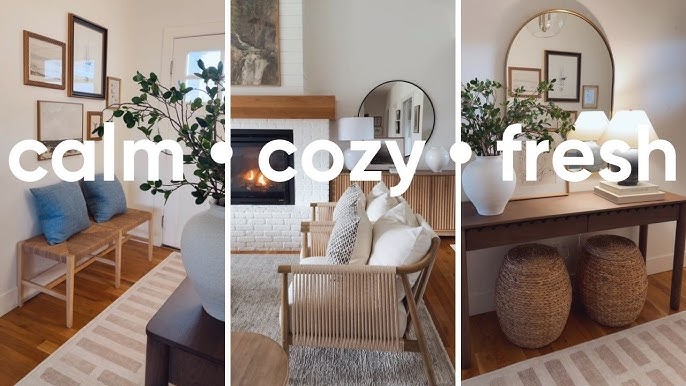
How to Style Your Home Like a Designer (Without the Budget)
There's a reason professionally designed rooms stop you in your tracks. It's not always the price tag on the furniture. It's not the square footage. It's a set of specific decisions — about scale, proportion, texture, and layering — that most people were never taught to make. The good news: every one of those decisions is learnable, and most of them cost nothing at all.
This is the guide professional designers don't always spell out. It covers the principles that actually separate a pulled-together room from one that just has nice stuff in it. Apply even a few of these, and the difference will be immediate.
1. Stop Decorating by Room. Start Decorating by Home.
The most common mistake people make is treating every room as its own isolated project. They buy a bedroom set for the bedroom, a sofa set for the living room, and kitchen decor for the kitchen — and then wonder why the house feels disjointed.
Designers think in whole homes. They establish a palette — typically two or three neutrals and one or two accent colors — and carry those tones from room to room. The exact shades don't need to match. But the family of colors should feel intentional as you move through the space.
|
Designer Principle: The 60-30-10 Rule Every well-designed room follows a color ratio: • 60% dominant color (walls, large furniture, rugs) • 30% secondary color (curtains, secondary seating, bedding) • 10% accent color (throw pillows, decorative objects, art) This applies to every room, and the palette ties your whole home together. |
2. Layer Your Lighting (This Is Non-Negotiable)
If you're relying on a single overhead light source in any room, that room is never going to feel designed. Overhead lighting flattens a space. It removes shadow, which removes depth, which makes everything feel like a motel.
Designers layer three types of light in every room:
• Ambient light: The base layer. Overhead fixtures, recessed lights, chandeliers. These set the room's overall brightness.
• Task light: Directed light for a specific purpose. Reading lamps, under-cabinet kitchen lighting, vanity lights.
• Accent light: The layer that creates mood. Table lamps, floor lamps, picture lights, candles. This is where the warmth lives.
You don't need to rewire anything. Adding a single floor lamp and two table lamps to a living room that only had overhead lighting will transform the way the room feels at night — immediately.
3. Treat Textiles as Architecture
Textiles are the most underused tool in home styling. Most people pick curtains, throw pillows, and blankets for their color alone. Designers pick them for texture, weight, and movement — and they layer them the same way they layer lighting.
In a single living room, a designer might use:
• A low-pile wool or jute rug for grounding
• Linen curtains with enough body to drape well
• A chunky-knit or waffle-weave throw on the sofa
• Velvet or leather accent pillows for contrast
• A cotton or boucle upholstered chair
None of those pieces need to match. They need to speak the same material language — natural fibers, matte finishes, organic textures. The moment you mix velvet with polyester satin, the room reads as cheap regardless of what anything cost.
The same principle applies to the bathroom. A Turkish cotton waffle towel doesn't just feel better — it reads better. The honeycomb texture has a visual quality that terry cloth simply can't replicate, and it signals that the bath was styled, not just stocked.
4. The Designer Swap Table: Small Changes, Big Results
Most rooms don't need to be emptied and started over. They need a handful of specific swaps. Here are the most impactful ones, and why they work:
|
What Most People Do |
The Designer Swap |
Why It Works |
|
Matching furniture sets |
Intentionally mixed pieces in a cohesive color palette |
More character, less showroom |
|
Overhead lighting only |
Layer floor lamp + table lamp + natural light |
Instant warmth and depth |
|
Bare walls everywhere |
One large-scale art piece or gallery wall per room |
Draws the eye, anchors the space |
|
Throw pillows in one size |
Mix 24", 20", and 18" in varied textures |
Layered, curated look |
|
Curtains hung at window height |
Hang curtains at ceiling height, floor length |
Makes ceilings feel taller |
|
Matching everything on a coffee table |
Odd-number groupings with varied heights |
Organic, editorial feel |
|
Generic bath towels |
Waffle-weave linen or Turkish cotton in neutral tones |
Spa-quality texture and look |
5. Edit Ruthlessly. White Space Is Not Wasted Space.
Overcrowding is the single fastest way to make a room feel chaotic and cheap — regardless of what's in it. Designers know this, which is why editing is as important as selecting.
Walk through each room and ask: does every object earn its place? A room where each piece was chosen intentionally will always outperform a room packed with things that drifted in over time.
Practical rules to edit by:
• Coffee table: no more than 3–5 objects, grouped in odd numbers, varied in height
• Shelving: leave 30–40% of the shelf open — the empty space is what makes the objects on it feel curated
• Walls: one strong focal piece beats five small pieces at the same eye level
• Surfaces: if it doesn't belong there, doesn't serve a purpose, or doesn't bring you genuine pleasure, remove it
6. Scale Everything to the Room, Not to the Furniture
Wrong-sized furniture and art are two of the most common tells of an unstyled room. A small rug that floats in the middle of a large living room looks like an afterthought. A tiny piece of art centered on a large wall looks lost.
Sizing rules designers actually use:
• Rug: front legs of all major seating should sit on the rug, or all legs should. Nothing floating.
• Art: aim for pieces that are roughly 2/3 to 3/4 the width of the furniture beneath them
• Coffee table: should be about 2/3 the length of the sofa
• Curtain rod: mount 4–6 inches above the window frame, and extend 6–12 inches past each side
Most of this costs nothing to fix — it's about placement and proportion, not purchasing.
7. Anchor Every Room With One Intentional Piece
Designers call it the hero piece — one item in a room that carries the room's entire point of view. It might be a statement sofa, an oversized piece of wall art, a dramatic light fixture, or a beautifully styled console table.
Everything else in the room supports and responds to that piece. When you have a clear hero, the rest of the decisions become easier — because you have something to design around.
At S.W. Home, every piece in the home decor collection is selected with this in mind — pieces that can serve as the focal point of a room or complement one. Nothing generic, nothing disposable.
The Bottom Line
Designing a home that looks expensive isn't about spending more. It's about making intentional decisions — about color, light, texture, scale, and restraint. Apply one principle at a time, starting with the room you spend the most time in, and the difference will compound quickly.
The best-designed homes feel personal. They feel like someone made choices. If you're ready to start making those choices with pieces worth building around, browse the full S.W. Home collection — and take a look at how Studio Wildwood uses these same pieces to build rooms worth living in.
|
Start Styling Smarter Every piece in the S.W. Home collection is hand-picked to work beautifully together — so you can build a home that looks intentional, not assembled. Browse home decor, textiles, bath accessories, and more. |
