

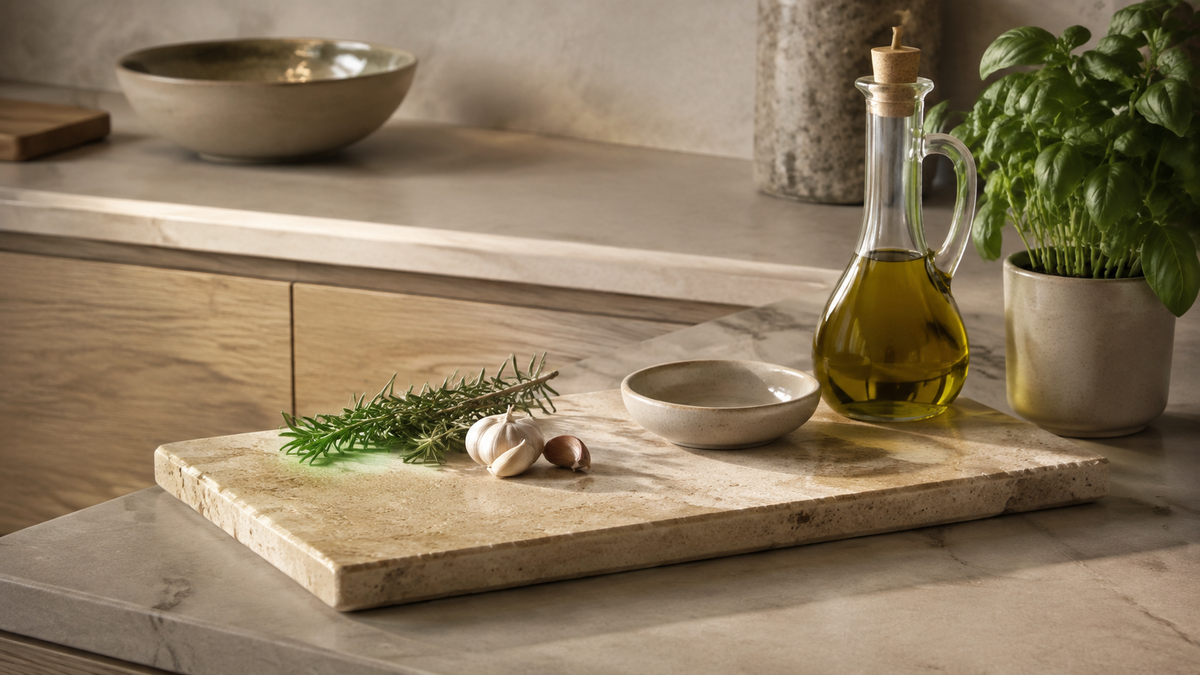
How to Style Kitchen Countertops Without Clutter
Kitchen countertops work best when the objects on them support everyday routines. The goal is not to remove all personality, but to group useful pieces, vary height and texture, and preserve generous workspace.
Good design begins with the way a room is actually used. Measure carefully, choose materials that suit the household, and leave enough open space for each element to feel intentional.

Edit Before You Decorate
Remove duplicates, rarely used appliances, and anything better stored in a drawer. Daily-use pieces should earn their space through usefulness or beauty.
Before committing, test the arrangement from the main doorway and from the places where people sit or move through the room. Small adjustments to scale, spacing, and repetition often make a larger difference than adding another object.
Create Functional Zones
Group oils and salt near the range, coffee supplies near the machine, and boards near the prep area. A tray or stone board visually contains each zone.
Before committing, test the arrangement from the main doorway and from the places where people sit or move through the room. Small adjustments to scale, spacing, and repetition often make a larger difference than adding another object.
Layer Natural Materials
Combine warm wood, stone, ceramic, glass, and one aged-metal accent. Their contrasting textures create depth within a quiet palette.
Before committing, test the arrangement from the main doorway and from the places where people sit or move through the room. Small adjustments to scale, spacing, and repetition often make a larger difference than adding another object.
Use Height Carefully
A crock, lamp, branch, or upright board adds vertical interest. Avoid blocking cabinet doors, ventilation, outlets, or sightlines.
Before committing, test the arrangement from the main doorway and from the places where people sit or move through the room. Small adjustments to scale, spacing, and repetition often make a larger difference than adding another object.
Protect Clear Workspace
Preserve at least one uninterrupted preparation area. Empty space is part of the design and makes the kitchen easier to clean.
Before committing, test the arrangement from the main doorway and from the places where people sit or move through the room. Small adjustments to scale, spacing, and repetition often make a larger difference than adding another object.
Common Mistakes to Avoid
Avoid buying by appearance alone, overcrowding the surface, or forcing every finish to match. Confirm dimensions, care instructions, and daily function first. A restrained palette and clear hierarchy will keep the result calm and lasting.
For complementary furniture and accents, explore the S.W. Home collection and the curated home decor collection.
Frequently Asked Questions
How many items should stay on the counter?
Keep daily-use tools and a few intentional accents while preserving prep space.
How should I group decor?
Use a tray or board to contain related items and vary their heights.
Can wood and stone mix?
Yes. The contrasting textures create a warm, layered look.
What belongs near the stove?
Only suitable, frequently used items positioned according to safety guidance.
How can I add color?
Repeat one muted color through pottery, linen, or a botanical.
Bring the Look Home
Thoughtful rooms balance beauty, usefulness, and personality. Start with the essential piece, build in layers, and edit until every item earns its place.

