

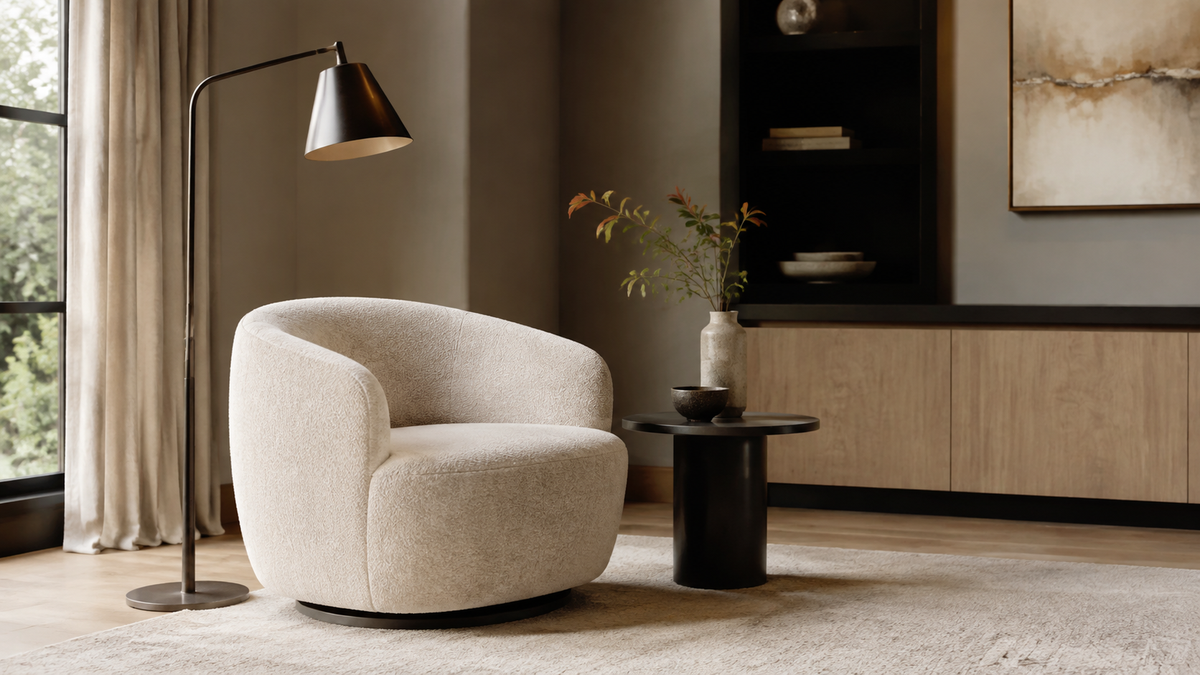
How to Choose a Swivel Chair for Your Living Room
A swivel chair can turn from conversation to a window, fireplace, television, or adjoining room. That flexibility is valuable in open plans, but scale, comfort, fabric, and a clear rotation path determine whether the chair truly works.
Good design begins with the way a room is actually used. Measure carefully, choose materials that suit the household, and leave enough open space for each element to feel intentional.
Plan the Full Swivel Footprint
Measure overall width and depth, then account for the arms and corners as the chair rotates. Tape the complete area on the floor.
Before committing, test the arrangement from the main doorway and from the places where people sit or move through the room. Small adjustments to scale, spacing, and repetition often make a larger difference than adding another object.
Match Seat Depth to the User
Deep seats encourage lounging; upright seats suit reading and conversation. Compare height, depth, back support, arms, and firmness.
Before committing, test the arrangement from the main doorway and from the places where people sit or move through the room. Small adjustments to scale, spacing, and repetition often make a larger difference than adding another object.
Choose Upholstery for Real Life
Consider pets, children, sunlight, food, and frequency. View fabric swatches in both morning and evening light before deciding.
Before committing, test the arrangement from the main doorway and from the places where people sit or move through the room. Small adjustments to scale, spacing, and repetition often make a larger difference than adding another object.
Connect Multiple Zones
Use one chair to bridge a living room and reading corner, or place a pair opposite a sofa. Keep side tables outside the rotation path.
Before committing, test the arrangement from the main doorway and from the places where people sit or move through the room. Small adjustments to scale, spacing, and repetition often make a larger difference than adding another object.
Balance Shape and Scale
Rounded chairs soften rectangular sofas and tables. Avoid blocking key views, and relate the back height to surrounding seating.
Before committing, test the arrangement from the main doorway and from the places where people sit or move through the room. Small adjustments to scale, spacing, and repetition often make a larger difference than adding another object.
Common Mistakes to Avoid
Avoid buying by appearance alone, overcrowding the surface, or forcing every finish to match. Confirm dimensions, care instructions, and daily function first. A restrained palette and clear hierarchy will keep the result calm and lasting.
For complementary furniture and accents, explore the S.W. Home collection and the curated home decor collection.
Frequently Asked Questions
How much room does a swivel chair need?
Allow the full footprint plus clearance for arms and corners to rotate.
Are swivel chairs good in small rooms?
Yes when one seat must face several zones, provided dimensions stay compact.
Should it match the sofa?
No. A complementary fabric or shape adds useful contrast.
Is it good for reading?
Choose supportive dimensions with a light and table nearby.
Can it sit on a rug?
Yes, when the base is fully supported on a flat, stable rug.
Bring the Look Home
Thoughtful rooms balance beauty, usefulness, and personality. Start with the essential piece, build in layers, and edit until every item earns its place.

