

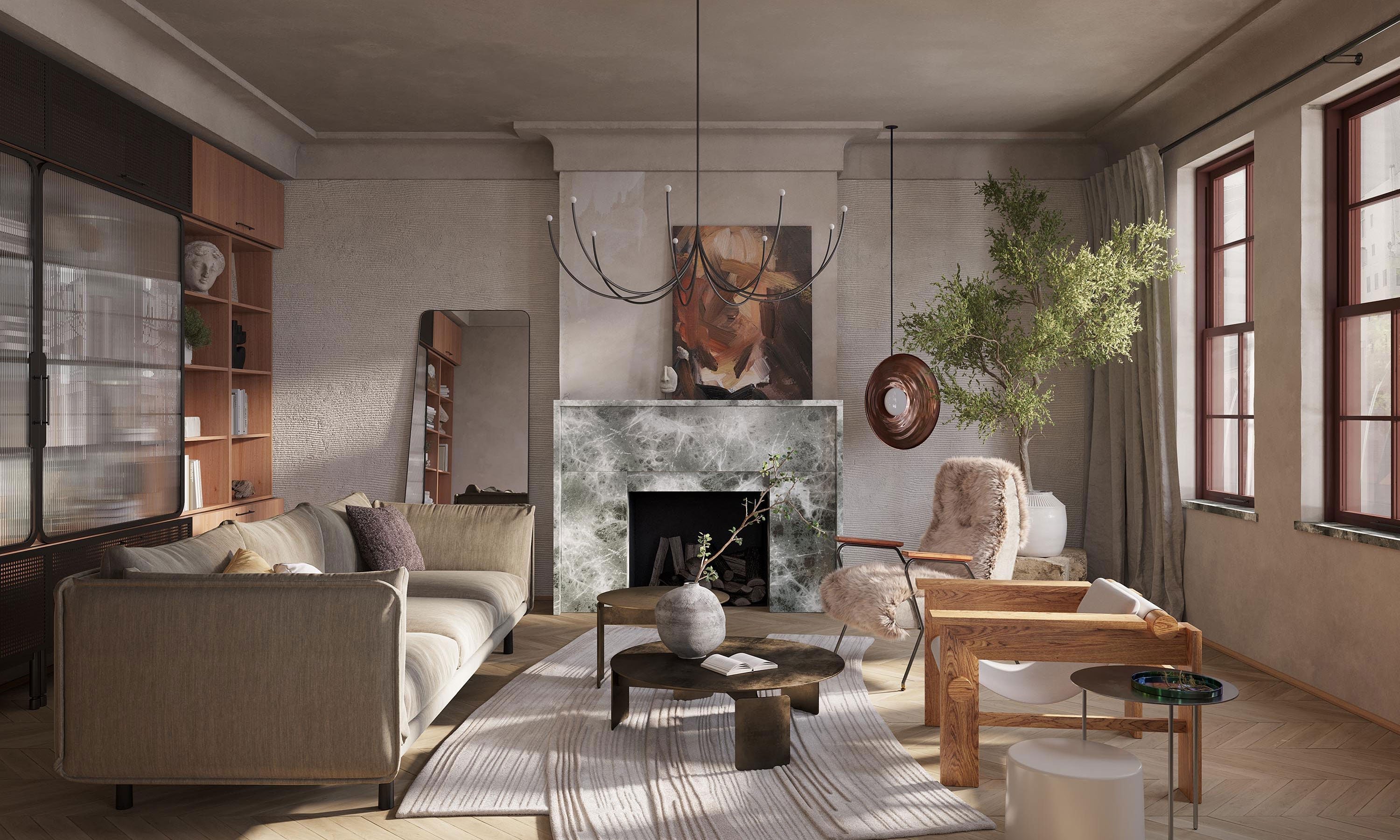
House Decor Trends We're Obsessed With This Year
Not all decor trends are worth following. Some arrive loud and leave fast, taking your investment with them. Others signal something real — a shift in how people want to live, what they value in a home, and what kind of beauty actually holds up over time.
The trends worth paying attention to this year all share something in common: they move toward permanence, not novelty. Natural materials over synthetic ones. Quiet over maximalist. Pieces with craft and character over fast-produced, fast-replaced decor. If the homes you admire most feel warm, considered, and genuinely personal — these are the trends driving that.
1. Warm Minimalism Is Replacing Cold Minimalism
The all-white, perfectly bare aesthetic that defined minimalism for the better part of a decade is giving way to something warmer and more livable. Warm minimalism keeps the restraint — clean lines, edited surfaces, no clutter — but swaps the cool tones and hard surfaces for something with more soul.
What it looks like in practice: cream and warm white instead of bright white, linen instead of cotton poplin, wood instead of lacquer, matte ceramic instead of glossy porcelain. The palette is warm-neutral — sand, clay, oat, stone — rather than the stark contrasts of the previous decade.
This is a trend worth investing in because it's not really a trend — it's a correction. Homes have always felt better with warmth in them. The design world is simply catching up to what most people already knew.
• How to bring it in: swap cool-toned linens and accessories for warm neutrals; introduce natural wood tones to any room that skews too white or gray; choose matte finishes over glossy ones wherever you have a choice.
2. Sculptural and Organic Forms
The era of perfectly geometric, symmetrical home objects is fading. In its place: pieces that feel like they were made by hand, shaped by a maker rather than produced by a machine. Irregular edges, asymmetrical forms, surfaces that show the mark of their making.
This shows up most clearly in ceramics, vases, decorative bowls, and sculptural objects — the kinds of pieces that sit on a coffee table, a shelf, or a console table and earn their place not just by filling space but by being genuinely interesting to look at.
The key distinction between sculptural objects done well and sculptural objects done poorly is authenticity. Mass-produced approximations of handmade forms almost always read as exactly what they are. The real thing — or something that shares the aesthetic sensibility of the real thing — reads immediately differently.
• How to bring it in: add one organic-form ceramic or decorative object to your coffee table or entry console; look for pieces with visible texture, irregular shape, or evidence of making; resist matching sets in favor of collected-feeling groupings.
3. Layered Textiles and Tactile Richness
This is the trend that most directly translates to how a home feels, not just how it looks. Layered textiles — varied textures, natural fibers, pieces with physical presence — are one of the defining characteristics of homes that feel genuinely luxurious without necessarily being expensive.
The shift happening now is toward textiles with real texture: waffle weave, boucle, chunky linen, raw cotton, woven rattan. These are materials that reward touch and catch light differently throughout the day. They make a room feel inhabited rather than staged.
In the bathroom specifically, Turkish cotton waffle towels have become the defining textile of this moment — lightweight, fast-drying, and visually distinctive in a way that standard terry cloth simply isn't. In the bedroom, linen bedding follows the same logic: texture that reads as luxury, performance that holds up to daily use.
• How to bring it in: start with the textiles you touch most — bedding, towels, throw pillows — and replace synthetic or low-texture versions with natural fiber alternatives; layer two or three different textures in any given room rather than matching them.
|
The Textile Upgrade That Pays the Most Dividends If you're going to make one textile investment this year, make it in the pieces you interact with every day: bath linens and bedding. The logic is simple — you use them constantly, you feel them constantly, and the quality difference between mass-market and considered textiles is immediately obvious. Specifically: waffle-weave or linen bath towels in a warm neutral (white, ivory, stone, or warm gray), and linen or percale cotton bedding in the same palette. These two upgrades change the daily experience of your home more than almost any decorative purchase. Browse S.W. Home's textile and bath collection to find both. |
4. Earthy, Nature-Derived Color Palettes
After years of gray dominating home interiors, color is returning — but not the saturated, high-contrast color of previous cycles. The palette of the moment is drawn directly from the natural world: terracotta, warm clay, dusty sage, raw linen, deep moss, washed ochre.
These colors share a quality: they look different in different lights. A terracotta wall reads warm amber at noon and deep rust at dusk. A sage green shifts between blue and yellow depending on the hour. This responsiveness to light is one of the things that makes nature-derived colors feel alive in a way that formula-matched neutrals often don't.
The practical move: introduce earthy tones through paint (the highest-impact, lowest-cost change in any room), then reinforce them through textiles and accessories. Large furniture in these palettes is a longer-term commitment and worth approaching carefully.
• How to bring it in: paint one wall or an entire room in a warm clay or terracotta tone; bring in terracotta, amber, or olive-toned ceramic and textile accents; pair earthy colors with raw wood and natural fiber textiles for maximum coherence.
5. The Vintage and New Mix
One of the most significant shifts in home decor over the past few years is the collapse of the matched-set mentality. Rooms furnished entirely from a single era, a single retailer, or a single aesthetic increasingly read as lacking character.
The homes that feel most alive right now mix vintage or antique pieces with contemporary ones — a mid-century side table alongside a modern sofa, a found ceramic object on a newly built console table, a vintage textile layered over current bedding. The mix creates a sense of accumulated life that no amount of new furniture can replicate.
This isn't about buying cheap vintage to save money — it's about recognizing that older pieces often have better proportions, better materials, and more interesting history than their contemporary equivalents. A good vintage piece is almost always worth more than a new reproduction.
• How to bring it in: identify one room where a single vintage piece — a side table, a ceramic lamp, a piece of art — would add character; visit estate sales, antique markets, or online vintage platforms with a specific object in mind rather than browsing generally.
6. Handmade and Artisan Craft
Mass production has delivered enormous value in home furnishings, but it has also produced a sameness that increasingly feels hollow. The counter-movement — toward handmade objects, artisan craft, and pieces that carry evidence of their making — is one of the more meaningful shifts in home decor right now.
This shows up in the growing appetite for hand-thrown ceramics, woven textiles, hand-carved wood objects, and hand-poured candles — pieces where the maker's hand is visible in the finished object. The value isn't just aesthetic. It's the knowledge that something singular exists in your home that exists nowhere else in quite the same way.
• How to bring it in: add one handmade or artisan piece to each room — a ceramic bowl, a hand-woven basket, a carved wood object; buy from makers whose work you've seen enough of to understand their sensibility; prioritize this in the objects that sit at eye level and get daily attention.
7. Quiet Luxury in the Bathroom
The bathroom has become one of the most intentional rooms in the home. Where it was previously an afterthought — a functional space that got whatever was left in the budget — it's now treated as a personal retreat, styled with the same care as a living room or bedroom. The driving aesthetic is quiet luxury: nothing showy, nothing trendy, everything chosen for quality and sensory experience.
The specific elements that define this look: waffle-weave or linen towels in neutral tones, stone or ceramic soap dispensers, a single piece of wall art, natural light maximized, clutter eliminated. The bathroom that feels like a spa isn't the one with the most features — it's the one with the fewest unnecessary things and the highest quality in the ones that remain.
• How to bring it in: start with the towels — they're the most visible textile in the room and the one you interact with most; decant products into matching dispensers and remove everything from the counter that doesn't earn daily use; add one framed piece of wall art at eye level.
Trend Longevity at a Glance
Not every trend is worth the same investment level. Here's how this year's most compelling directions compare:
|
Trend |
How to Invest |
Longevity |
Key Elements |
Watch Out For |
|
Warm Minimalism |
Invest freely |
Several years at minimum |
Neutral palette, natural materials |
Timeless direction, not a trend cycle |
|
Sculptural Objects |
Invest selectively |
3–5 years |
Organic forms, matte finishes |
Skip trendy shapes; buy what moves you |
|
Layered Textiles |
Invest freely |
Always relevant |
Natural fibers, varied textures |
Quality over quantity every time |
|
Earthy Color Palette |
Invest in paint + large pieces |
3–5 years |
Terracotta, clay, warm whites |
Avoid in fast-fashion materials |
|
Vintage + New Mix |
Invest in vintage anchors |
Enduring approach |
One-of-a-kind character pieces |
Patience required; rewards are real |
|
Handmade & Artisan |
Invest in hero pieces |
Growing, not fading |
Ceramics, woven textiles, wood |
Authenticity reads immediately |
|
Quiet Luxury Bath |
Invest in towels + fixtures |
Multi-year staying power |
Waffle weave, linen, stone |
The upgrade that pays daily dividends |
How to Use Trends Without Being Used by Them
The mistake most people make with trends is chasing them wholesale — redecorating entire rooms around a moment that will pass. The smarter approach is to treat trends as a lens for evaluating individual purchases, not a mandate for a full overhaul.
A practical framework:
• Invest in trends that align with your existing aesthetic. A trend that requires you to change your entire palette or swap major furniture pieces is a trend you should probably observe rather than follow.
• Enter trends through textiles and accessories first. These are the lowest-commitment, lowest-cost way to test a direction before committing to larger pieces.
• Ask whether the piece works outside the trend context. If you can only imagine it in the specific trend moment it came from, it will date. If it works in multiple contexts across time, it's worth buying.
• Ignore trend content that moves faster than a season. Design trends that cycle in months are marketing, not design. The ones worth watching develop over years.
The trends listed here are worth following because they point toward something lasting: homes that feel genuinely personal, materially honest, and built for real life. That's not a trend. That's just good design, arriving on a schedule.
Browse the S.W. Home collection for home decor and textiles that align with where design is actually headed — warm, natural, and worth living with for years.
|
Shop Trends Worth Investing In S.W. Home carries pieces that align with where design is actually headed — warm, natural, considered, and built to last beyond next season. Browse the full collection and find what belongs in your home. |
