

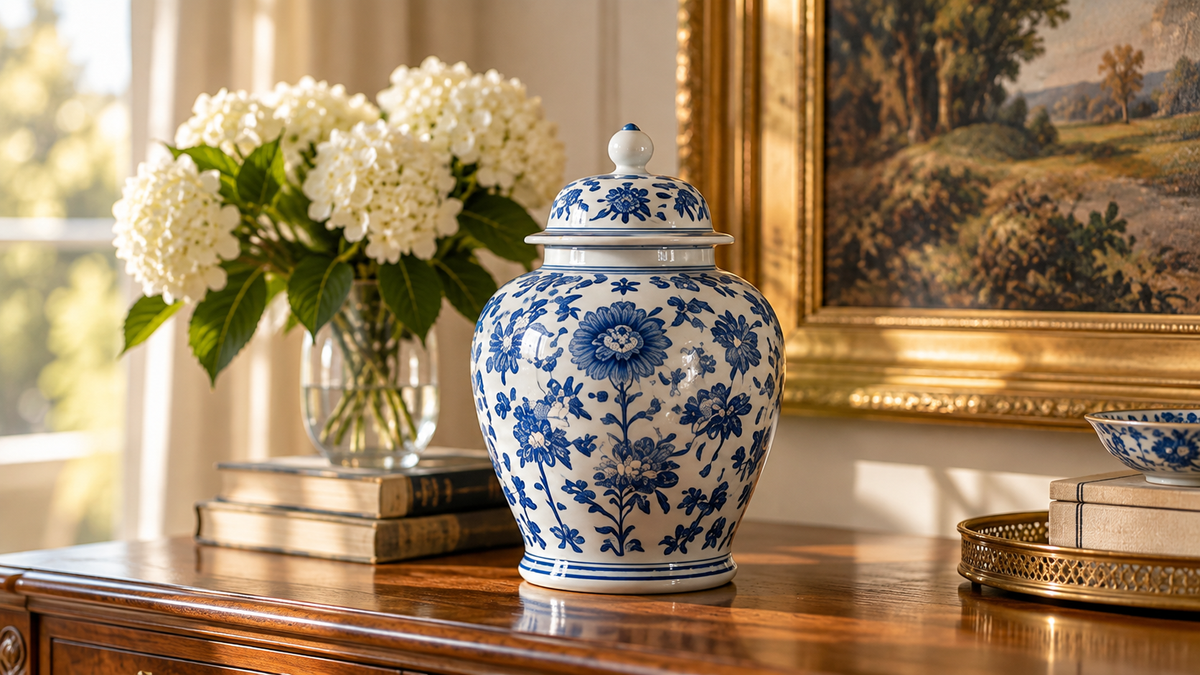
Ginger Jar With Lid: The Decorative Object With 1,000 Years of History Behind It

The ginger jar is one of the most enduring forms in decorative objects — recognizable across centuries, across cultures, and across decorating styles from traditional to contemporary. A ginger jar with lid is simultaneously a piece of history and a functional object you can use right now, in any room, in almost any aesthetic context. This is what you need to know.
What Is a Ginger Jar?
A ginger jar is a round-bellied ceramic vessel with a short, straight neck and a domed lid. The form originated in China during the Song Dynasty (960–1279 AD) and was originally used to store and transport spices — ginger among them — via trade routes. The distinctive silhouette was determined by function: a wide belly to hold volume, a narrow neck to limit oxidation, a tight-fitting lid to seal the contents.
By the time European traders encountered ginger jars through the porcelain trade in the 16th and 17th centuries, the form had already been refined over hundreds of years. The blue-and-white chinoiserie decoration that became most associated with ginger jars in Western markets was produced in Jingdezhen, China, specifically for export.
The Ginger Jar With Lid: Why the Lid Matters
A ginger jar without its lid is a vase. The lid is what transforms it into a closed vessel — an object with enclosure, with the sense that something inside has been contained and presented. The lid also adds height and silhouette: the domed lid echoes the rounded belly and creates a complete, balanced form.
When buying a ginger jar, the quality of the lid fit is one of the most immediate quality signals. The lid should seat firmly and lift cleanly without wobbling or catching.
Ginger Jar Styles
• Blue and white chinoiserie: The original and most recognized format. Blue cobalt decoration on white ceramic. Works in traditional, coastal, and transitional rooms
• Solid glaze: A solid-color glaze in a single tone — white, cream, sage, navy, black. More contemporary and adaptable to modern rooms
• Modern pattern: Geometric, abstract, or botanical patterns in a non-chinoiserie palette. Contemporary takes on the classic form
• Matte finish: Matte black, matte white, or matte clay. The most current finish. Works in minimal and organic-modern rooms
• Metallic: A ginger jar in brass, gold-finished metal, or mixed metal and ceramic. Statement pieces with high visual impact
How to Use a Ginger Jar With Lid in Modern Rooms
• As a decorative object: On a mantel, a console table, or a bookshelf as a sculptural ceramic object — the form is strong enough to stand alone
• As a vase: The belly of a ginger jar holds a generous amount of water. Remove the lid and use it as a vase for large-scale arrangements or statement branches
• As a vessel: A large ginger jar holds dried botanicals, decorative stems, or reed diffusers
• Practical storage: A medium ginger jar holds remotes, pens, or small items. The lid keeps the contents concealed
Sizing Guide
|
Size |
Best Placement |
|
Small (6–8 inch) |
Bookshelf, nightstand, bathroom counter, grouped with other objects |
|
Medium (10–14 inch) |
Console table, coffee table, mantel — the most versatile size |
|
Large (16–20+ inch) |
Floor placement, entryway, mantel centerpiece, statement shelf |
Grouping Ginger Jars
A single ginger jar is a statement. Two matching jars create symmetry — formal and classical, best on a mantel or flanking a mirror. Three jars in varied sizes creates a collection: use the same color family with different scale, or the same finish in different heights.
|
Find ginger jars and decorative objects at S.W. Home → shopswhome.com |
