

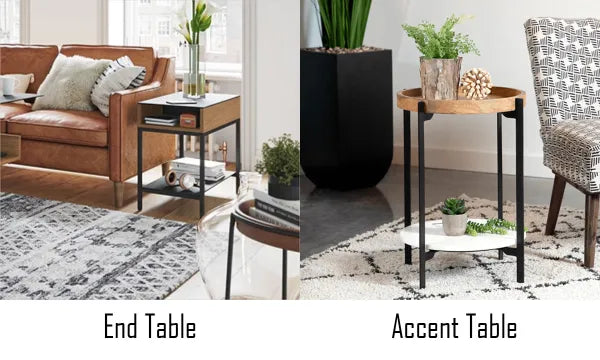
End Tables vs. Side Tables: What's the Difference and Which Do You Need?
The terms end table and side table get used interchangeably in most furniture conversations — and in most furniture stores. They're not the same thing. The distinction matters because the wrong choice for a specific spot creates proportional problems that no amount of styling will fix.
This guide settles the difference once and for all, explains when to use each, and covers the sizing, material, and style decisions that make either choice work correctly in a real room.
The Technical Difference
End tables sit at the end of a sofa — specifically at the arm of a sofa, where the sofa meets a wall or the edge of the seating arrangement. They're typically square or rectangular, sized to sit flush with or just below the sofa arm, and positioned to serve one specific seat.
Side tables is the broader category — any small table placed beside a seat for functional support. End tables are a type of side table, but side tables also include the round pedestal table beside an armchair, the drum table flanking a bed, and the C-table that slides under a sofa arm. The category is defined by function (serving the person seated next to it), not by shape or placement.
In practical use: if it's at the end of a sofa, it's an end table. If it's beside any other seat, it's a side table. If it's beside a bed, it's a nightstand — which is also a side table.

Height: The Rule That Doesn't Change
Regardless of which type you're choosing, the height rule is the same: the table surface should sit within two inches of the arm of the adjacent seat — either above or below. This gives comfortable reach from a seated position and creates a visual connection between the furniture pieces.
|
Seat Type |
Typical Arm Height |
Ideal Table Height |
Notes |
|
Standard sofa |
23–25" |
22–26" |
Most end tables sized for this range |
|
Low-profile / mid-century sofa |
18–22" |
18–23" |
Verify before buying — arm heights vary widely |
|
Deep sectional |
20–26" |
Measure specifically |
Sectionals vary most; always measure |
|
Armchair / accent chair |
24–28" |
24–28" |
Check each chair individually |
|
Bedroom (queen mattress) |
~25" (top of mattress) |
24–28" |
Slightly above mattress top is ideal |
|
Reading chair / chaise |
Varies 18–28" |
Match arm height ±2" |
C-table works well if space is tight |
When an End Table Is the Right Choice
End tables are purpose-built for the end-of-sofa position. Choose one when:
• Your sofa is against or near a wall. The end table fills the gap between the sofa arm and the wall and creates a visual anchor at the corner of the seating arrangement.
• You need a lamp at that position. End tables are typically sized to hold a lamp and one or two other objects — the classic lamp-and-surface function.
• The sofa has a defined end. L-shaped sectionals and sofas that terminate at a specific point benefit from an end table that caps the arrangement.
• You want matching symmetry. Two matching end tables, one at each end of a long sofa, create the formal symmetry that suits traditional and transitional rooms.
When a Side Table Is the Better Choice
The broader side table category gives you more options for non-sofa-end contexts:
• Beside an accent chair or armchair. A round pedestal or small drum table works better here than a rectangular end table — it fits the curved geometry of the chair without hard corners competing with the room.
• In a tight space. A C-table, nesting tables, or a slender pedestal take up far less floor space than a standard end table while delivering the same function.
• For a floating sofa. A sofa placed in the middle of a room, not against a wall, often benefits from a side table on one end and a sofa table behind it rather than matching end tables at both ends.
• As a nightstand. Small side tables work as nightstands when the standard nightstand height matches the mattress — a round side table beside a bed is a legitimate and often more interesting choice.
|
The Nesting Table Advantage Nesting tables — two or three tables of graduated sizes that store under each other — solve the flexibility problem that single end or side tables can't. They provide a large surface when you need it and collapse to a small footprint when you don't. In living rooms that serve multiple purposes (everyday living plus entertaining), nesting tables at one or both ends of a sofa are worth serious consideration. They also make it possible to try different configurations without buying multiple tables — pull them apart to serve different seats or stack them when the room needs more open floor space. |
Style Matching: Do End Tables Need to Match Each Other?
In bedrooms: yes, in most cases. Matching nightstands on either side of the bed create the symmetry and calm the room benefits from.
In living rooms: not necessarily. Two matching end tables on either end of a sofa is the traditional approach — and it works. But intentionally mismatched end tables that share a material or finish create a more personal, collected look. A metal-legged round side table on one end and a square wood end table on the other can work if they share a wood tone, a metal finish, or a height.
The unifying element can be subtle. It just needs to exist.
The Full Table Family: How End Tables, Side Tables, Console Tables, and Coffee Tables Relate
|
Table Type |
Typical Size |
Typical Position |
Primary Function |
|
End table |
18–26" H, 18–24" W/D |
At sofa arm, against wall |
Lamp + surface beside one seat |
|
Side table |
18–30" H, 14–24" W/D |
Beside any seat |
Surface support for adjacent seat |
|
Nightstand |
24–30" H, 18–24" W/D |
Beside bed |
Lamp + essentials at sleeping height |
|
Coffee table |
16–20" H, 36–60" L |
In front of sofa |
Central surface for seating group |
|
Console / sofa table |
28–36" H, 12–16" D |
Behind sofa or against wall |
Display surface, room definition |
|
Nesting tables |
Graduated heights |
End of sofa or beside chair |
Flexible multi-surface option |
Browse the full range of home tables and furniture at S.W. Home — including accent pieces, decorative objects, and textiles that complete any seating arrangement.
|
Find the Right Table for Every Spot S.W. Home carries home decor and accent furniture chosen for quality, proportion, and lasting style. Browse the full collection. |
