

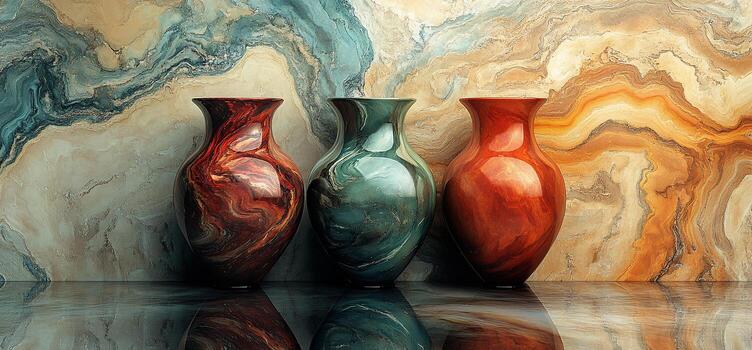
Decorative Vases: How to Choose, Style, and Arrange Them in Any Room
A vase is one of the most underestimated decorative objects in a home. Most people think of it as a vessel — something to put flowers in. But a well-chosen vase is a sculptural object in its own right: it has form, material, color, and texture, and it contributes all four to any surface it's placed on whether or not it holds anything at all.
This guide covers how to choose a decorative vase that works in your specific room, the colorblock and ceramic styles that are defining the current moment in home decor, and the arrangement principles that make a group of vases read as a collection rather than a shelf of random objects.

The Vase as Object, Not Just Container
The shift in how designers think about vases has been significant: from container to object. A vase chosen for its sculptural quality — its silhouette, its surface, its material — contributes to a room whether it holds flowers, dried stems, a single branch, or nothing at all.
This reframing changes how you shop for one:
• Evaluate the form first. Does the silhouette interest you on its own? A vase with a distinctive profile — a narrow neck, a widened shoulder, an asymmetric form — reads as a designed object. A perfectly cylindrical vessel relies almost entirely on its surface and what's inside it.
• Consider the surface quality. Matte glazes read as warm and organic. Glossy glazes catch and scatter light. Textured surfaces add tactile quality that's visible even from across the room. The surface is part of the object's contribution to the room, not just a background for whatever it holds.
• Think about what it will look like empty. The most useful vases are beautiful both ways — with something inside and without. If a vase only reads as attractive when full of flowers, it's doing half the work a good piece should do.
The Colorblock Vase: Why the Format Works
A colorblock vase — a vessel where the body is divided into two or more distinct color zones — is one of the most visually interesting formats in contemporary decorative objects. The design logic is simple: two colors in the same object create their own visual conversation, and the division line between them (whether sharp or graduated) adds architectural interest to the form.
Colorblock vases work across a range of room styles because the effect scales:
• In a neutral room: a colorblock vase with one warm tone and one neutral (cream over terracotta, white over sage) becomes the room's accent color moment without overwhelming the palette.
• In a room with existing color: a colorblock vase that picks up one of the room's existing tones and pairs it with a neutral creates a connection between the vase and the broader room.
• As a standalone object: a high-contrast colorblock vase (deep navy over white, black over cream) is strong enough to be the only decorative object on a surface — it doesn't need accompaniment to read as a complete moment.
Ceramic vs. Glass vs. Stone: Material Guide
|
Material |
Visual Quality |
Best With |
Styling Notes |
|
Matte ceramic |
Warm, organic, handmade feel |
Dried botanicals, cotton stems, single branches |
Most versatile — works in every palette |
|
Glossy ceramic |
Polished, clean, contemporary |
Fresh flowers, colored glass accents |
Higher visual impact; pairs best with simple surroundings |
|
Textured ceramic |
Dimensional, artisan, earthy |
Empty, or with a single stem |
The texture is the main event |
|
Clear glass |
Clean, transparent, disappears |
Fresh flowers, colored water |
Shows stems — use quality, fresh-cut flowers only |
|
Colored glass |
Rich, jewel-toned, atmospheric |
Single stems, branches, dried material |
Amber and green especially timeless; choose thick glass |
|
Stone / terracotta |
Heavy, grounding, permanent |
Single dramatic stems, empty |
Heavy enough to be a sculpture; anchor any grouping |
Sizing and Grouping: How Vases Work Together
A single vase is an accent. Two or three vases grouped together are a collection. The principles that make groups read as curated:
• Vary the height significantly. A tall vase (12"–18"), a medium vase (7"–10"), and a short vase or vessel (3"–5") creates the height variation that makes any grouping dynamic. Uniform height flattens the arrangement.
• Keep the material consistent, vary the form. Three ceramic vases in different shapes — one narrow and tall, one wide-shouldered, one low and open — read as a collection because the material connects them. Three vases in three different materials often read as unrelated objects.
• Let the fills differ. A tall vase with a single dramatic branch, a medium vase with dried pampas grass, and a small vessel empty or with a tiny succulent — different treatments at different heights create depth and visual interest throughout the grouping.
• Add a non-vase element. A small ceramic dish, a stack of books, or a tray beneath the grouping extends the arrangement beyond the vases and integrates them with the surface's broader styling.
|
The Single Stem Approach The single stem in a narrow-necked vase is one of the most effective — and most underused — vase styling approaches. One ranunculus, one tulip, one cherry blossom branch, one dried cotton stem. The restraint of a single stem makes both the stem and the vase visible in a way that a full arrangement doesn't allow. This approach works especially well with vases that have beautiful forms or distinctive glazes — the single stem frames the vase as much as the vase holds the stem. It also works in tight spaces where a full arrangement would overwhelm the surface. |
Placing Vases in Every Room
• Living room coffee table: a medium vase as part of a three-object grouping — alongside a ceramic object and a stack of books. Position the vase at the tallest point of the grouping.
• Console or entryway table: a tall vase with a single dramatic branch or a loose arrangement of pampas grass creates immediate vertical impact at eye level as you enter.
• Dining table centerpiece: low and wide (under 12") to keep sightlines clear, or dramatically tall (above 24") to clear them entirely. The awkward middle height blocks conversation.
• Bedroom nightstand: a small vase or vessel with a single stem adds organic life to a nightstand surface without crowding it.
• Kitchen shelf: a ceramic vase as a non-functional display object on an open kitchen shelf adds a room's worth of texture in a single piece.
Find colorblock vases, ceramic vessels, and decorative objects at S.W. Home — objects selected for their sculptural quality and lasting visual appeal.
|
Shop Decorative Vases at S.W. Home Colorblock vases, ceramic vessels, and decorative objects hand-picked for their beauty as objects — not just containers. Browse the S.W. Home collection. |
