

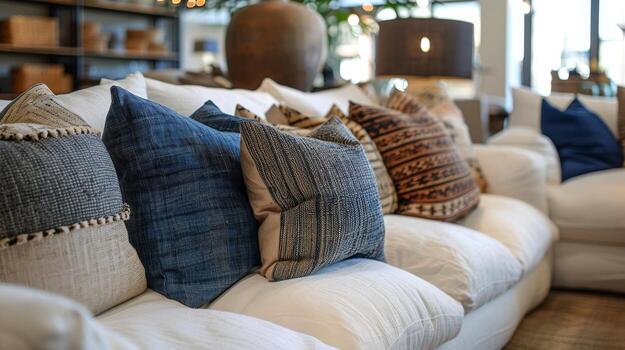
Decorating With Throw Pillows: The Rules That Actually Work
Throw pillows are the most repositioned objects in any home and the most reliably mishandled. Too many, all the same size, perfectly matched, too flat, too symmetrical — any one of these produces a sofa that looks like a showroom rather than a room someone lives in. Decorating with throw pillows well is a skill, and it comes down to a specific set of decisions made in a specific order.
This is the guide to getting those decisions right — from the size formula that designers use to the mixing logic that makes any arrangement look curated rather than random.

Start With Size: The Foundation of Every Arrangement
The most common throw pillow mistake is buying everything in one size. Uniform size produces a flat, monotonous arrangement regardless of how beautiful the individual pillows are. Variation in size creates depth, movement, and the layered quality that makes a sofa look professionally styled.
The standard formula for a three-cushion sofa:
• Two 24" square pillows at the outer ends — the anchors. Largest and most structural.
• Two 20" square pillows layered in front of or offset from the 24s — the mid-layer.
• One 18" square or lumbar pillow in the center — the accent. Where the most expressive pattern or texture belongs.
Scale down for a two-cushion sofa: two 22" pillows and one 18" or lumbar. For an armchair: one 20" or 22" is enough — multiple pillows on a chair reads as crowded, not layered.
The Three-Pattern Rule
The most reliable pattern-mixing formula involves three distinct categories in one arrangement:
• One solid or texture-only pillow. The visual rest. Boucle, linen, waffle weave, velvet, or cotton in a solid color. This is where the eye pauses between patterns — essential for preventing a busy arrangement from reading as chaotic.
• One small-scale or geometric pattern. Thin stripes, small checks, subtle grids, micro-prints. Visual interest without competition.
• One large-scale statement pattern. A bold print, large geometric, abstract mark, or expressive textile. This is the pillow that carries the arrangement's personality.
The unifying thread across all three: pull one or two colors from the statement pattern and ensure they appear in the others — as the dominant color of the solid, or as an accent in the geometric.
Texture Mixing: What Works Together
|
Texture |
Works Well With |
Avoid Pairing With |
Notes |
|
Linen |
Velvet, boucle, leather, cotton |
Synthetic satin, polyester |
Most versatile neutral — the universal mixer |
|
Velvet |
Linen, cotton, leather |
Another velvet piece |
Rich — use as one element, not the whole arrangement |
|
Boucle |
Linen, cotton, smooth leather |
Heavy printed fabrics |
Texture-forward; simplify surrounding patterns |
|
Cotton waffle |
Almost anything |
Nothing — the ultimate mixer |
Neutral texture that complements every other fabric |
|
Embroidered |
Solid linen or cotton |
Other embroidered or heavily printed |
Make it the statement; everything else recedes |
|
Leather / faux leather |
Linen, cotton, woven textures |
Velvet (both too high-texture together) |
Best as one accent piece in a mixed arrangement |
The Lumbar Pillow: The Most Underused Format
|
Why Every Sofa Needs a Lumbar A lumbar pillow — rectangular, typically 14" x 22" or 12" x 20" — introduces a horizontal element that breaks the vertical rhythm of a standard pillow stack. It's also the most visible position in any arrangement: centered on the sofa at the front of the styling. This makes it the ideal place for the most expressive pattern or the most distinctive texture in the arrangement. A beautifully crafted lumbar in a statement fabric with square neutrals behind it is the formula professional stylists use most reliably. On a daybed or chaise, position the lumbar at one end with one or two square pillows at the other. This creates a natural resting configuration rather than a pile of pillows at the same end. |
Arrangement Styles That Work in Real Rooms
• Symmetrical: matching pillows at each end, accent in the center. Traditional and formal. Works best when the room itself has formal elements — traditional furniture, paired lamps, formal art.
• Asymmetrical: different pillows at each end, varied sizes staggered. More personal and collected. Requires more confidence but rewards it with a room that feels genuinely designed.
• Stacked: pillows layered front to back, largest at the back to smallest at the front. The most common professional approach — creates depth and makes the sofa look full without looking crowded.
• The casual lean: one or two pillows leaned at an angle against the sofa back rather than placed upright. Reads as relaxed and lived-in. Works in any style of room and requires no formula.
The Insert Is as Important as the Cover
A beautiful pillow cover on a poor insert will never look right — the cover can't drape, 'chop,' or hold its shape without a quality foundation underneath it.
• Down or down-alternative inserts give pillows fullness and the ability to recover their shape after being leaned against. Choose an insert one to two inches larger than the cover for a full, plump appearance.
• Polyester fiber fill compresses over time and loses its loft within months. It works for decorative pillows that aren't used daily, but not for a sofa people actually sit against.
• Cover closures: invisible zipper closures are the most professional finish. Envelope closures also work. A visible zipper on the front of a pillow undermines the quality of the fabric regardless of how good it is.
Browse S.W. Home's textiles and home accessories — including pillow covers and home decor that bring the same quality to every room.
|
Shop Textiles & Home Accessories at S.W. Home Pillow covers, textiles, and home accessories chosen for material quality and lasting style. Browse the S.W. Home collection. |
