

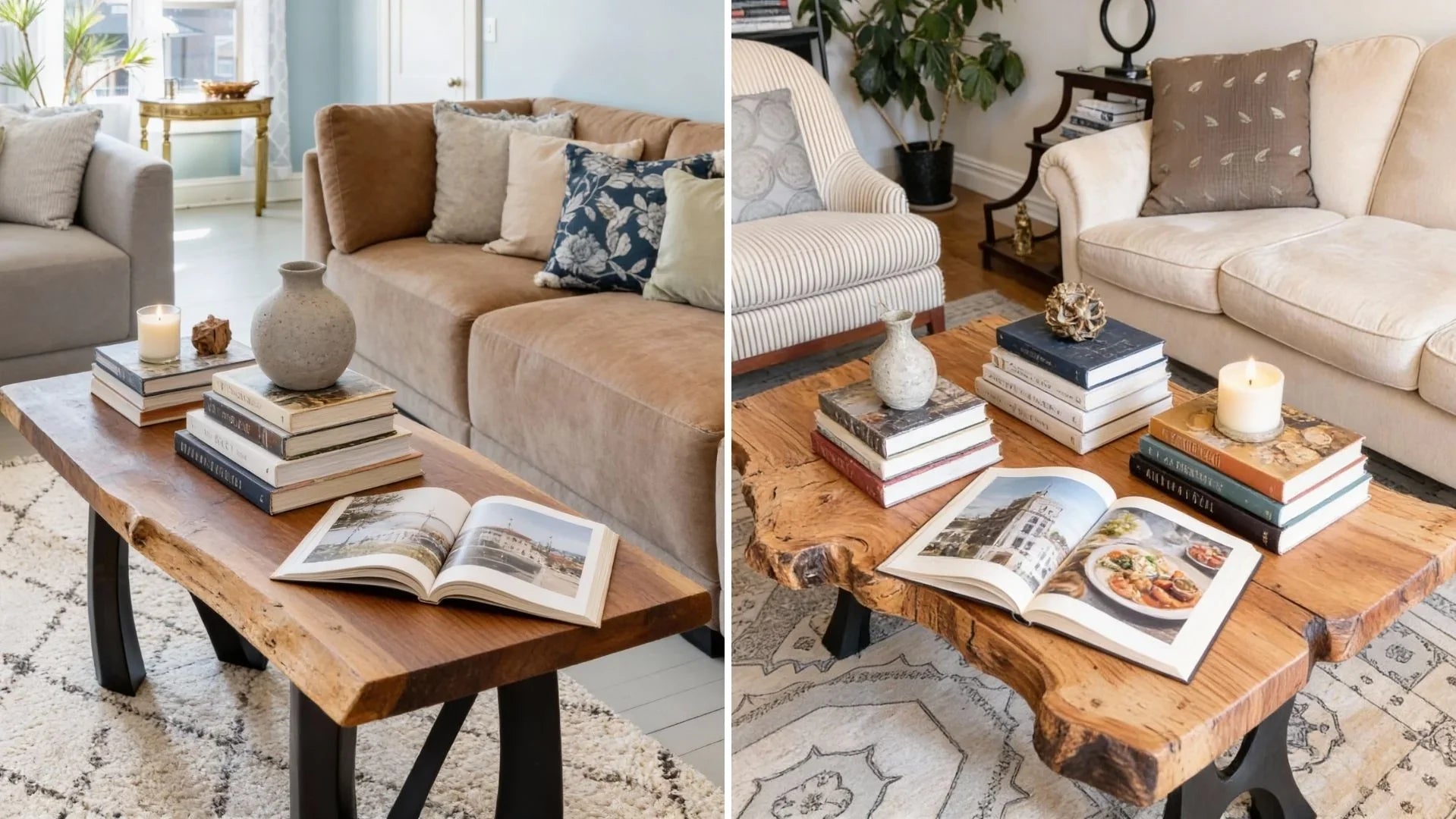
Coffee Table Styling: 7 Looks That Always Impress
The coffee table is the most styled surface in any living room — and the most often gotten wrong. Too crowded and it reads as clutter. Too bare and it feels like a placeholder. A well-styled coffee table is one of the fastest ways to make a living room feel designed, and it costs far less than a new sofa or rug.
This guide covers 7 distinct looks that work in real homes — from minimalist to maximalist — plus the core principles that make any coffee table styling approach feel intentional.
The Rules Before the Looks
Every great coffee table styling starts with three fundamentals. Get these right and the look almost styles itself.
|
The 3 Fundamentals of Coffee Table Styling • Odd numbers. Groups of 3 or 5 objects always look more organic than pairs or quads. Two candles feel symmetrical and stiff. Three feel collected. • Varied heights. A flat surface of same-height objects is visually boring. Every arrangement needs at least one tall element, one medium, and one low — even if the difference is just an inch or two. • Leave breathing room. At least 30–40% of the table surface should remain clear. The empty space is what makes the objects look chosen, not accumulated. |
Look 1: The Minimalist
Best for: Modern, Scandinavian, and Japanese-influenced interiors.
Less is more taken to its logical conclusion. A minimalist coffee table has almost nothing on it — and that restraint is exactly what makes it feel considered.
How to build it:
• One low tray in a natural material — stone, raw wood, or matte ceramic
• A single living or dried plant in a simple vessel
• One small sculptural object with an interesting form — not decorative in the obvious sense, but visually interesting
The key is that every object earns its place. Nothing is there because it was convenient. That intentionality is what makes minimalism feel like a design choice rather than an empty room.
Look 2: Organic and Natural
Best for: Bohemian, coastal, and nature-inspired interiors.
This look brings the outside in. The goal is warmth, texture, and materials that feel like they grew somewhere.
How to build it:
• A live-edge wood slice or woven basket as the anchor object
• Dried botanicals or pampas grass in an earthy vessel
• A chunky candle in terracotta or beeswax
• A stack of nature or travel photography books
Avoid anything shiny or synthetic. This look lives and dies by material authenticity — if it looks plastic, it breaks the spell.
Look 3: Layered and Curated
Best for: Transitional, eclectic, and collected interiors.
This is the look that says someone actually lives here — and has interesting taste. It takes the most thought to execute well, but rewards that effort with a room that feels genuinely personal.
How to build it:
• A decorative tray to anchor and contain one grouping
• A stack of 2–3 art or design books, spines facing out
• A small sculptural object on top of or beside the books
• A candle or small plant to bring in organic softness
• One loose object outside the tray — a coaster, a small stone, a found object
The tray does the organizing work. Everything inside it reads as a cohesive grouping. The one object outside the tray suggests that the space is actually used, not staged.
|
Pro Tip: The Book Stack Art books are the most versatile coffee table object. They add height, color, and intellectual texture simultaneously. Stack them spines-out for readability, use 2–3 maximum, and always place the largest book on the bottom. A small object on top — a stone, a small ceramic, a coaster — completes the stack and gives it a finished quality. |
Look 4: Bold and Graphic
Best for: Contemporary, maximalist, and high-contrast interiors.
This approach does the opposite of minimalism — but with just as much restraint. Instead of many small objects, it uses one or two large, visually powerful pieces to command the surface.
How to build it:
• One oversized decorative bowl, sculptural object, or architectural piece as the centerpiece
• One complementary object — a large candle, a tall vase, a book with a graphic cover
• Nothing else. The drama comes from the scale and the negative space around it.
This look works best when the hero object has real presence — something with an interesting silhouette, unusual material, or striking color. A generic bowl will not carry it.
Look 5: Seasonal
Best for: Any interior where variety and freshness matter.
This isn't a single look — it's a system. The base styling stays consistent year-round; one or two elements swap with the season to keep the room feeling alive.
How it works:
• Base layer (permanent): tray, books, one permanent sculptural object
• Spring/Summer swap: fresh botanicals, citrus in a bowl, linen napkins in a light color
• Fall swap: dried wheat, small pumpkins, warm-toned candles, woven textures
• Winter swap: pinecones, evergreen sprigs, cream candles, a small glass object that catches light
The swap takes five minutes and costs almost nothing. The room reads as curated every single month of the year.
Look 6: Traditional and Classic
Best for: Traditional, transitional, and formal living rooms.
Symmetry and formality are the defining characteristics here. This look suits rooms with more structured furniture profiles — tufted sofas, wingback chairs, antique or antique-inspired pieces.
How to build it:
• Symmetrical groupings — a matching pair of candlesticks, two identical objects flanking a central piece
• A floral arrangement or high-quality faux botanicals in a classic vessel
• A decorative box or small tray with a lid
• Crystal, porcelain, or silver-toned accents
The difference between traditional styling that feels elegant and traditional styling that feels dated is material quality. Crystal and porcelain read as classic. Plastic versions of those same forms read as cheap regardless of how they're arranged.
Look 7: Modern Organic
Best for: Contemporary homes that want warmth without going fully bohemian.
This is the most popular look right now, and for good reason — it bridges modern simplicity with the organic warmth that makes a room feel livable.
How to build it:
• A low, wide matte ceramic bowl — neutral toned, no gloss
• A single stem or small bunch of dried botanicals in a simple vessel
• A stack of design or architecture books with neutral covers
• One woven or textured element — a small basket, a linen napkin, a woven coaster stack
The palette for this look is almost always warm neutrals — cream, sand, warm gray, terracotta. Color comes from texture, not pigment.
The Full Styling Cheat Sheet
Here's how all 7 looks compare at a glance:
|
Look |
Key Objects |
Vibe |
Materials |
|
Minimalist |
1 tray, 1 plant, 1 object |
Negative space |
Linen, stone, ceramic |
|
Organic/Natural |
Wood slice, dried botanicals, woven basket |
Earthy warmth |
Jute, wood, terracotta |
|
Layered & Curated |
Books, candle, small sculpture, tray |
Collected over time |
Mixed: linen, marble, metal |
|
Bold & Graphic |
One oversized object or statement bowl |
Confident simplicity |
Lacquer, glass, brass |
|
Seasonal |
Swap one element per season (botanicals, textiles) |
Always fresh |
Whatever the season calls for |
|
Traditional/Classic |
Symmetrical groupings, floral, candle pair |
Balanced formality |
Porcelain, crystal, silk |
|
Modern Organic |
Low bowl, dried stems, art book stack |
Effortless but intentional |
Matte ceramic, paper, linen |
What Your Coffee Table Says About Your Room
A coffee table is the one surface in a living room that gets used and styled. It holds a drink and a book while also serving as the visual anchor of the entire seating area. That dual role is what makes it worth getting right.
The objects you put on it don't need to be expensive. They need to be intentional — chosen for their form, their material, and the way they work together. That's what separates a styled surface from a cluttered one.
If you're looking for pieces worth building a coffee table look around, browse the S.W. Home home decor collection — hand-picked objects that bring that same intention to every room. And if your living room's side tables or decorative accessories need the same treatment, the same principles apply.
|
Find the Objects Worth Styling Around Every piece in the S.W. Home collection is hand-picked to work beautifully in a layered, curated home — the kind of objects that belong on a coffee table, not hidden in a cabinet. |
